Disclosure: this comparison is published by Symposia, which is one of the tools listed below. Every alternative is linked so readers can verify the details independently.
Listed alphabetically — this is not a ranking. There’s no best tool here, only the one that matches how your society works.
All pricing and features verified August 2026 against each vendor’s own documentation.
At a glance
| Free option | Pricing published | Registration & payments | Attendee app |
|---|
| ConfTool | Yes — ≤150 participants, self-hosted | Pro: quote only | Yes, with VAT & invoicing | Via Conference4me |
| EasyChair | ≤20 submissions | Yes, per submission | Add-on service | No |
| Ex Ordo | No | No | Yes | Yes (Guidebook) |
| Oxford Abstracts | Yes — abstracts only | Yes | 2.5% of revenue | No |
| Symposia | No | Yes | Yes | Yes |
How to choose
Features aren’t the differentiator — every tool here handles submission and review competently. Four things actually decide it:
- What happens after acceptance. Abstracts are the solved problem. Programme building, registration, payments, the book of abstracts, and the on-site day are where societies lose weekends.
- Whether pricing is published. If you need a number for a budget line or a ministry funding application, a quote-only vendor adds weeks.
- Who does the setup. A powerful tool that takes a volunteer two weekends to configure isn’t cheap. The cost just moved.
- Whether next year starts from zero. Societies run the same conference annually with a rotating committee. If nothing carries forward, you re-solve it every year with a new person.
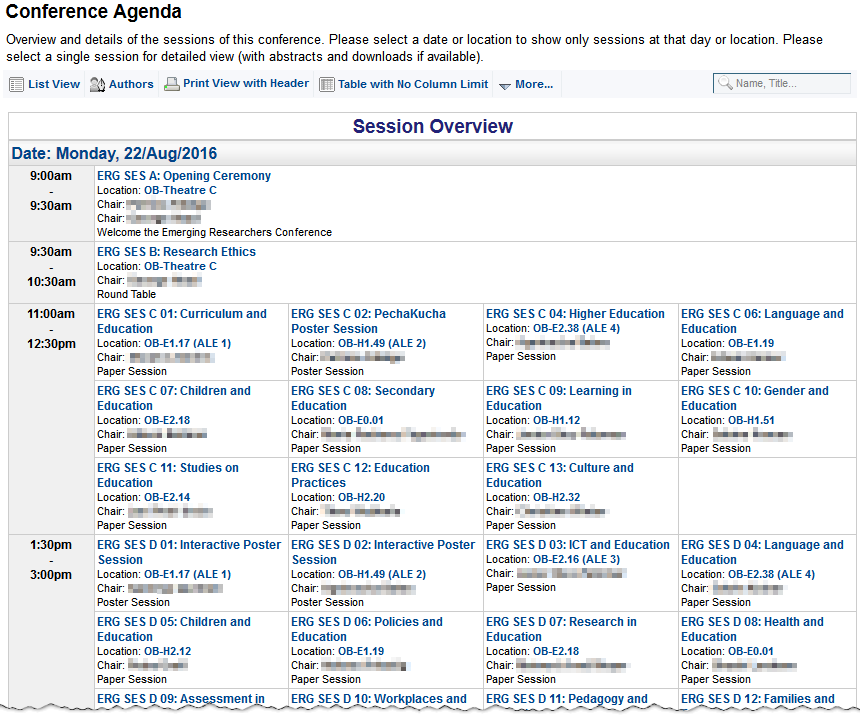
German (Hamburg), used for over 5,000 academic and non-academic events. Two editions.
Pros
- ConfTool Standard is genuinely free — licensed for non-commercial events run by academic, non-professional, non-regular organisers, up to 150 participants with moderate fees and student discounts.
- Thorough on complex European needs: multiple contribution types, sub-events, participant invoicing, VAT handling, GDPR, German servers.
- A German company with an EU VAT number, so invoicing European institutions is straightforward.
- Pro pricing is quote-only but transparently structured: a base fee by submission volume plus a per-participant fee after the event, with no hidden charges for extra user accounts, exports or printouts.
Cons
- The free Standard edition is local-install only and comes with no support — realistic only if someone in your society can run PHP/MySQL on a server.
- The 150-participant cap rules out mid-sized events.
- Pro requires a quote.
- The interface is functional rather than modern.
🔗 conftool.net
EasyChair
The default in computer science. Most academics already have an account.
Pros
- Zero reviewer onboarding — they’ve all used it.
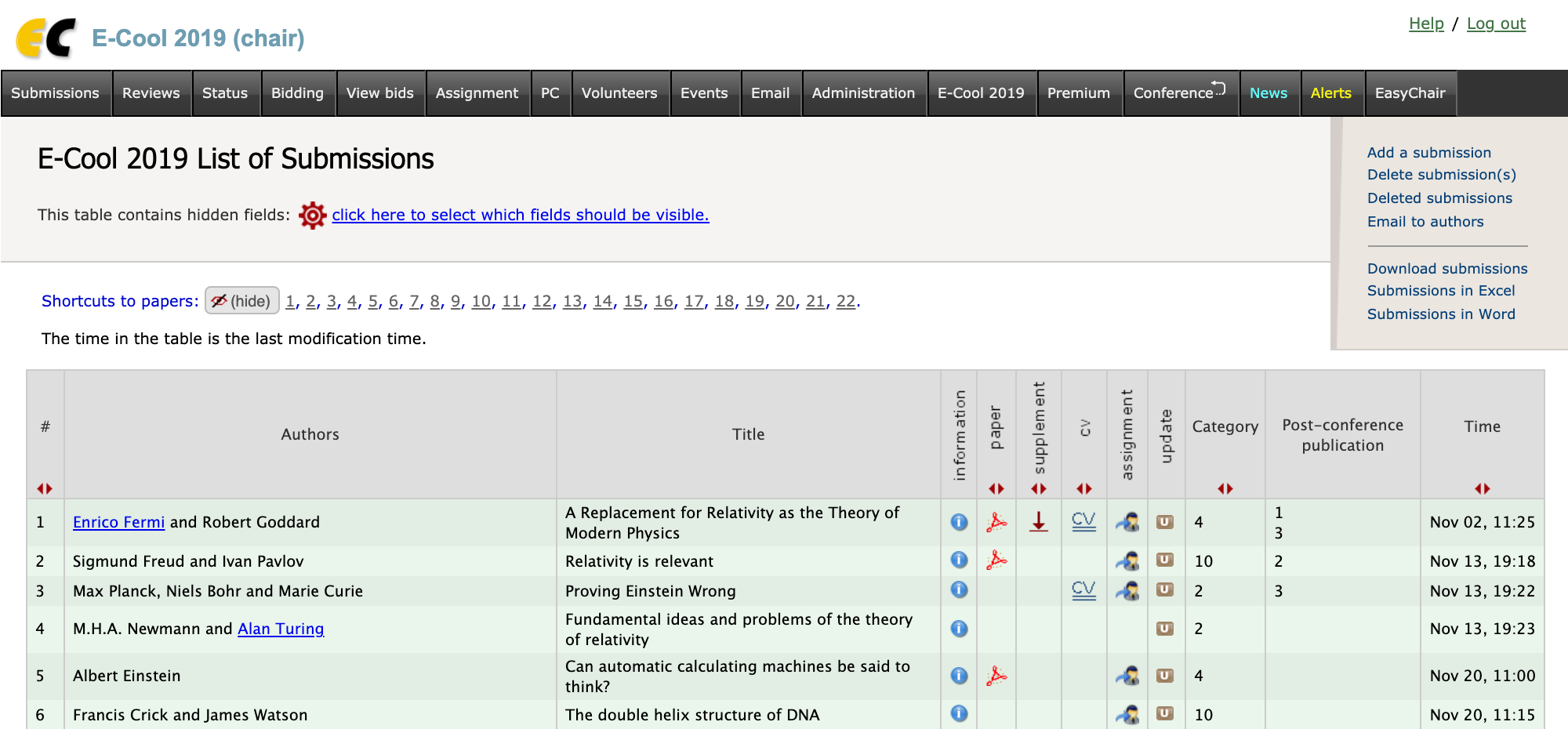
- The deepest peer review here: bidding, multi-phase rounds, rebuttals, subreviewers, conflict handling.
- Scales to very large volumes.
- Pricing is published and available in fifteen currencies, with volume discounts up to 40% at high submission counts.
- Executive and VIP licences integrate with IEEE copyright management and ACM and Springer proceedings.
Cons
- The free licence caps at 20 submissions — and once you exceed it, your conference is locked until you pay. For a mid-sized society conference, that means the free tier is not an option, whatever you may have assumed.
- Beyond free it’s per submission: $4 up to 60 submissions, from $6.20 above that.
- The interface has barely changed in two decades and first-time chairs consistently find it unintuitive.
- Support is paid-tiers-only; free users get none.
- Registration is a bolt-on service, not core.
🔗 easychair.org
Ex Ordo
Irish (Galway), founded 2011, raised over $3 million in 2023. Clients include IEEE and the American Chemical Society.
Pros
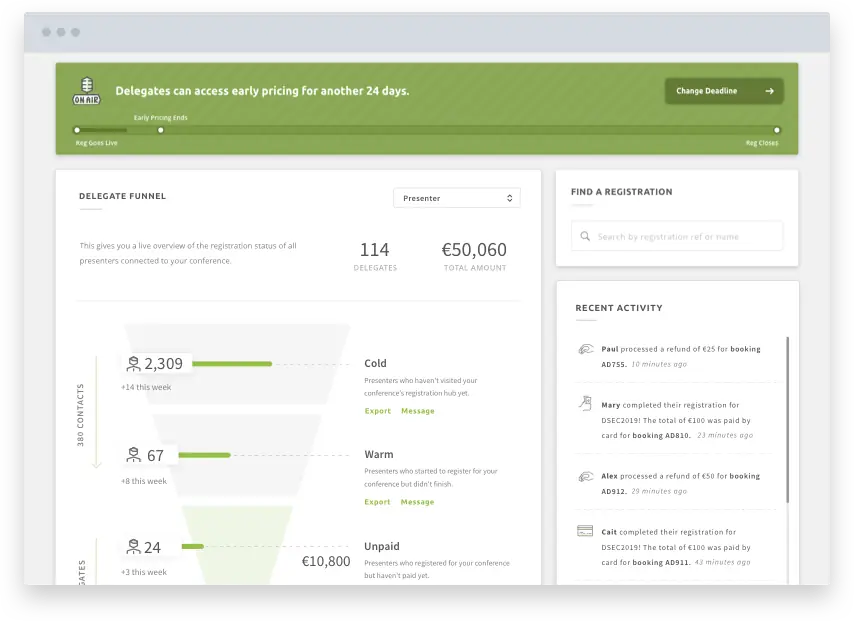
- The most complete academic stack among commercial vendors — abstracts, review, programme builder, registration with card and bank transfer, native attendee app via Guidebook, print-ready proceedings, hybrid support.
- A published 90-minute support response SLA, from an Irish office in European hours.
- Panels and symposia submissions (added April 2024) cluster for review and convert into programme sessions in one click, with a conflict checker.
- As an EU company, invoicing and GDPR are uncomplicated for European institutions.
Cons
- No public pricing at all — you cannot get a number without booking a demo. No self-serve free trial either.
- Positioned toward larger associations, so a small national conference may find both price and depth excessive.
- Post-event content stays online 60 days, which may not suit societies wanting a permanent archive.
🔗 exordo.com
Oxford Abstracts
UK, operating since 2001, built around abstracts and peer review.
Pros
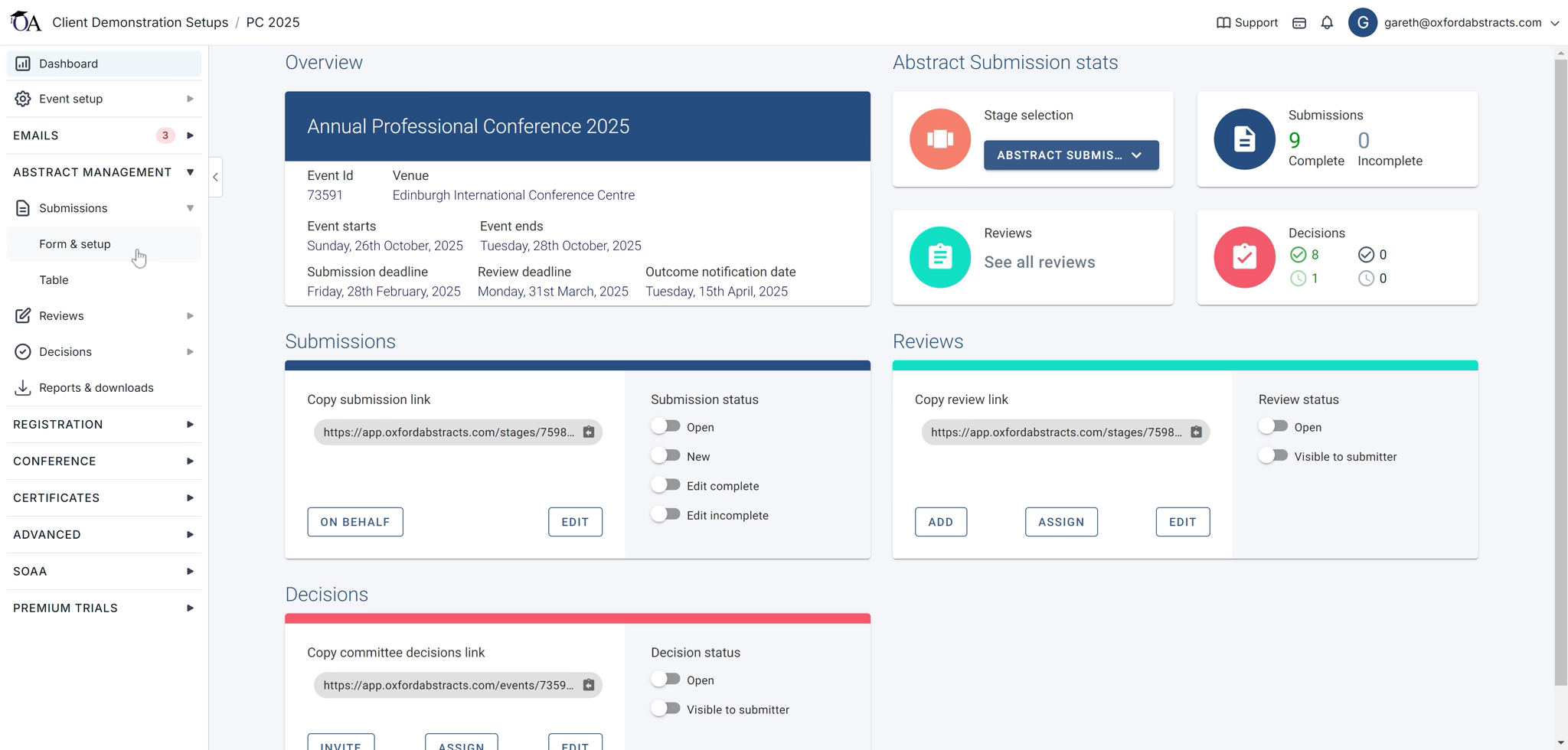
- The cleanest submission experience here for authors.
- A genuinely useful free tier with unlimited abstract submissions and unlimited reviewers.
- Strong single and double-blind review, multi-stage submissions, and a symposium module for panel submissions.
- Delegate registration is charged as 2.5% of registration revenue excluding VAT, capped at $5,000 per event with nothing up front — an unusually fair model if your conference is small.
- Payment by card or invoice on 30-day terms, which suits institutional procurement.
- UK support in European time zones.
Cons
- Lighter after acceptance — registration, payments and the website builder are add-ons rather than the core, so organisers commonly pair it with something else.
- No dedicated attendee app; mobile-responsive web only.
- The free tier excludes custom questions, custom emails, API access and custom reports, and carries Oxford Abstracts branding you can’t edit.
🔗 oxfordabstracts.com
Symposia
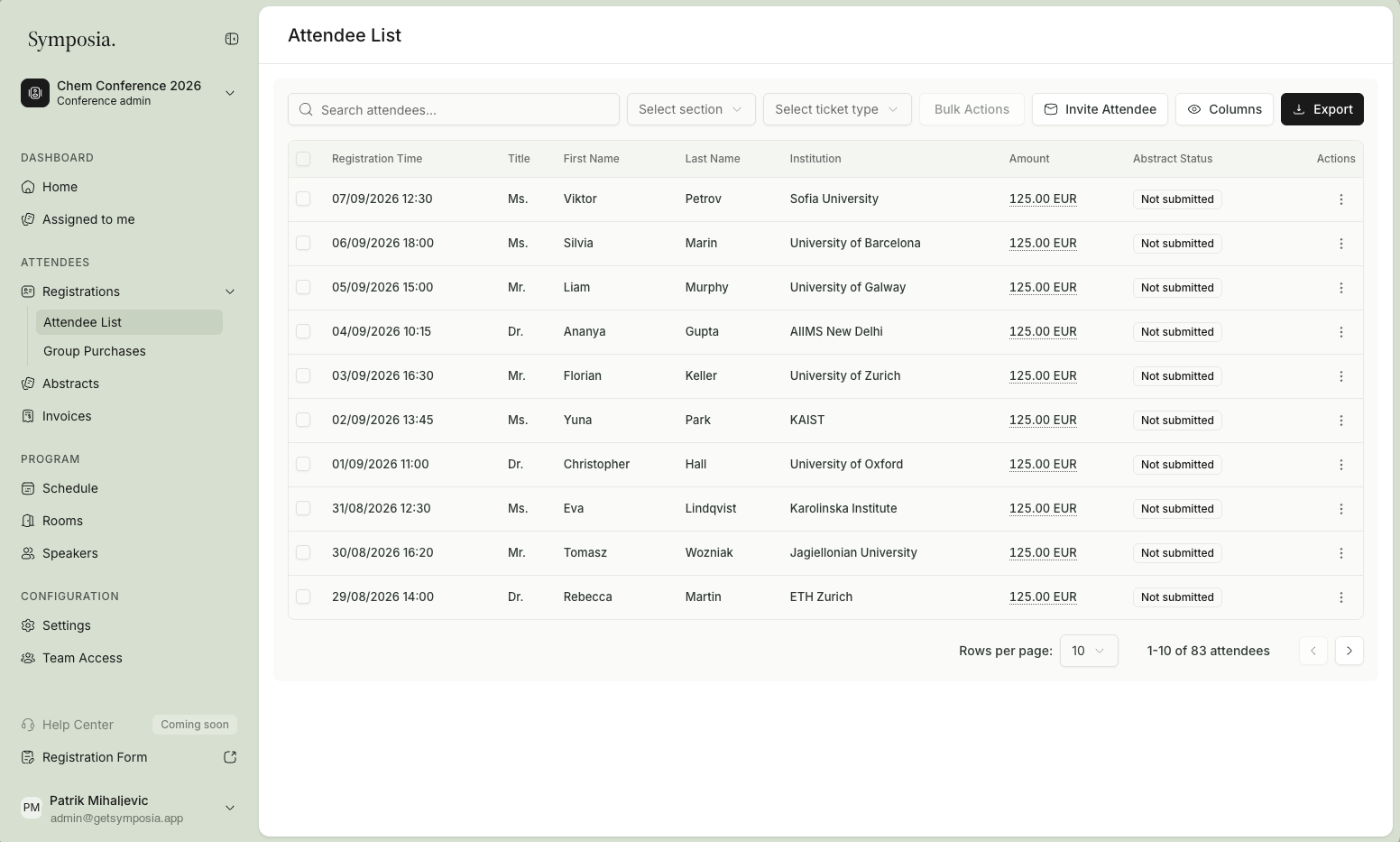
Built for academic and scientific societies across the EU that run a portfolio of events each year — a flagship congress plus section symposia, student meetings and specialist workshops — organised by society officers rather than professional conference organisers.
Pros
- Priced and structured around the portfolio, not the single event. Societies running several meetings a year manage all of them on one platform under one annual plan, instead of buying per-event licences or falling back to email and Word templates for the smaller ones.
- Covers abstract submission, peer review, participant registration, proforma invoicing, session scheduling and participant emails, plus an attendee mobile app — so the smaller events get the same tooling as the flagship.
- Pricing is published, so a number can go into a budget line or funding application without a sales call.
- Direct support from the people building the product, in European hours.
Cons
- The newest and smallest option here — the others have between fifteen and twenty-five years behind them. If institutional longevity is a procurement requirement, that is a real argument against it.
- Not built for thousands of submissions across dozens of tracks; Ex Ordo or EasyChair serve those conferences better.
- Peer review is deliberately simpler than EasyChair’s — no reviewer bidding, no multi-round rebuttals.
- Proceedings publishing with DOI assignment is on the roadmap, not shipped, so societies that need formal proceedings today should look elsewhere.
- Fewer third-party integrations than the established platforms.
- And for a single non-commercial event under 150 participants, ConfTool Standard costs nothing while Symposia does not.
🔗 getsymposia.app
Honourable mention: Microsoft CMT — free, sponsored by Microsoft Research, and still very much alive, with over 12,000 conferences hosted and a million users. Submission and review only: no registration, no programme building, no attendee side. Requires a chair with a valid university email, and site creation can take up to 72 hours. For a purely review-driven event with no budget, hard to argue with.
The short version
- Reviewers already live in EasyChair and your conference is large and technical? EasyChair — just budget for it, the free tier stops at 20 submissions.
- Abstracts and review are your only problem? Oxford Abstracts — their 2.5% registration model is fair for small events.
- Large association with real budget and a multi-track international conference? Ex Ordo.
- Complex European conference with a technical organiser — or a small non-commercial event under 150 people and someone who can run a server? ConfTool — in the second case, it’s free.
- A society running several meetings a year, with the flagship on real software and everything else on email and Word? Symposia — that gap is what it was built for.
There is no best tool here — there’s the one that fits your society, and four that don’t.